

Puzzles are simple, reusable and easy to fit into a family routine. While children search, turn and place pieces, they practice much more than matching a picture. Here are seven skills preschoolers can build through puzzle play.
1. Visual matching
Children compare colors, lines and shapes to decide where each piece may belong. Begin with a clear picture and fewer pieces, then increase the challenge gradually.
2. Spatial awareness
Turning a piece teaches that the same object can look different from another direction. Words such as edge, corner, above, below and beside help children describe what they see.
3. Fine-motor skills
Picking up, rotating and placing pieces calls for finger control and hand-eye coordination. Magnetic pieces can be especially useful for travel because they stay close to the play surface.
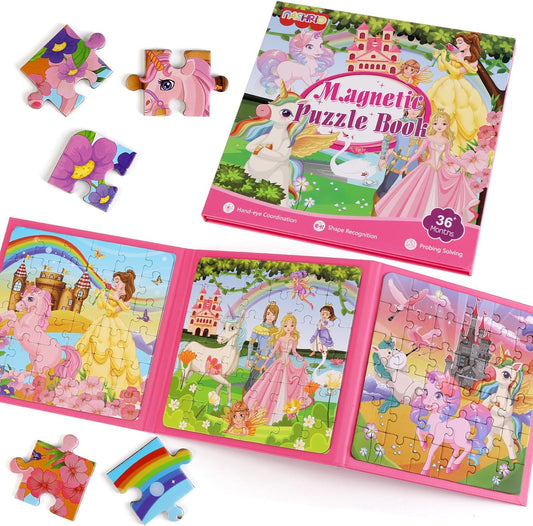
4. Planning and problem-solving
A child may start with corner pieces, group similar colors or test one piece in several spaces. Each strategy is a small experiment: try, observe and adjust.
5. Memory
After repeating a favorite puzzle, children begin to remember where familiar details belong. Ask “Where did the yellow piece fit last time?” without expecting an immediate answer.
6. Patience and confidence
A puzzle provides visible progress. Finding one correct piece can motivate a child to continue. If frustration rises, offer a limited clue—such as pointing to the correct area—while leaving the final placement to the child.
7. Conversation and cooperation
Puzzles can become a shared activity. Take turns choosing pieces, describe details in the picture and talk about the finished scene. This supports vocabulary and cooperative play.
Make puzzle time work for your child
- Choose the recommended age and a subject your child already enjoys.
- Use a clear table or tray so pieces are easy to see.
- Start with a short session and finish on a positive moment.
- Sort edge pieces or colors together when the puzzle feels difficult.
- Let children repeat the same puzzle; repetition builds mastery.
Planning a trip? See our screen-free travel activities for ages 3–6.